Record enough context to return to the Moment later.
Closed beta · pilot conversations open
KnowMyWhy for professionals
Keep the why visible alongside the provision.
The professional workspace is now in closed beta. It gives practitioners a proportionate way to record brief contextual observations, revisit patterns and support review while keeping the young person’s perspective visible.
A working professional flow
From a moment in the day to a more useful review.
The beta is designed around brief recording first and thoughtful review later. It keeps separate observations visible without turning them into automatic findings.
Keep their perspective, preferences and words visible alongside adult observations.
Notice repeated context, what helped and what may be worth trying next.
Use the picture to inform a conversation, review or support decision.
This is a reflective information journey, not an automated decision pathway. KnowMyWhy does not score risk, predict behaviour or decide what support a person needs.
Current closed-beta workspace
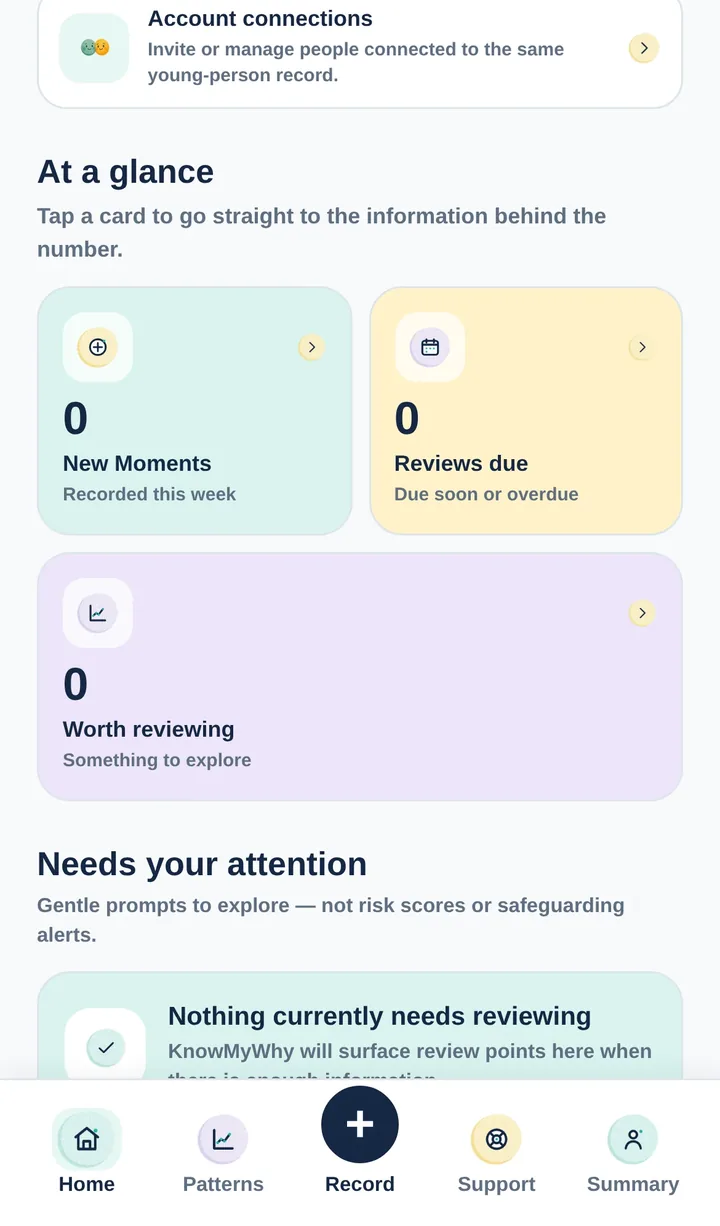
A recent picture across the young people you support.
The professional home brings recent Moments, upcoming reviews and areas worth revisiting into one place. Practitioners can open the exact item behind a prompt rather than working from a score or generic alert.
Review without scoring
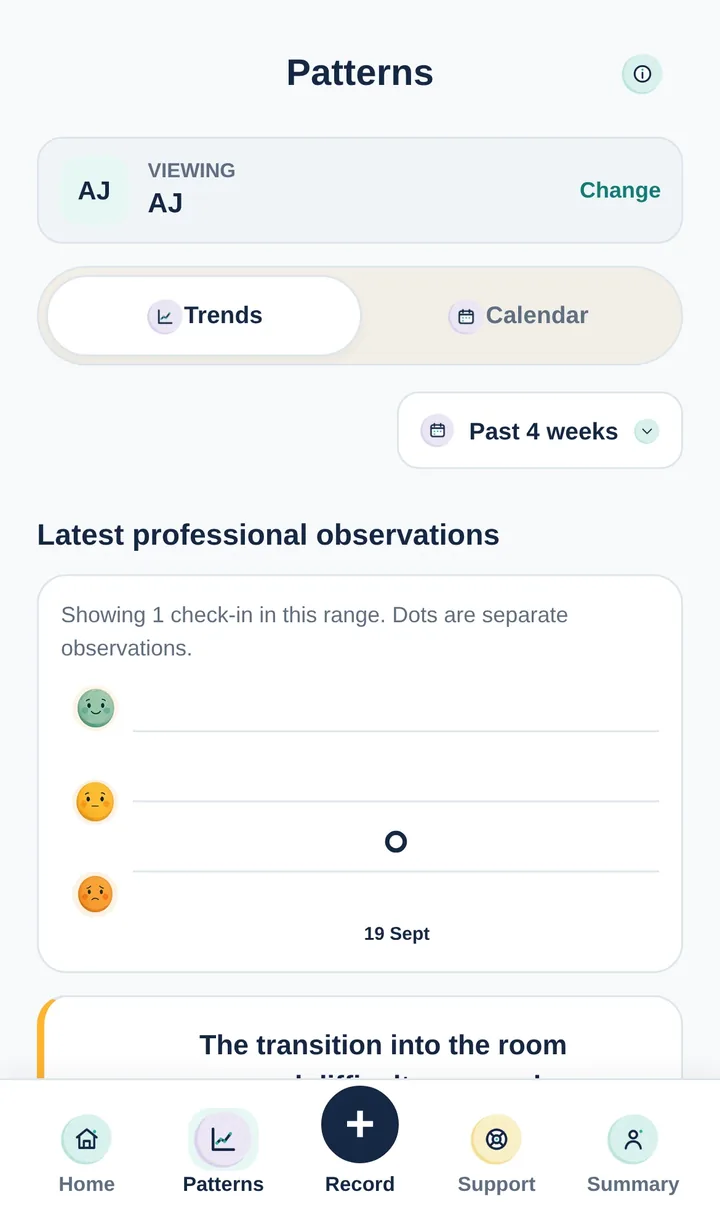
See what is repeating without turning a person into a data point.
Patterns are there to help a SENCo, teacher or practitioner ask better questions: what was happening, what seemed to help, and what deserves a closer look?
Home and school, when invited
A professional account can connect to an existing young-person record.
KnowMyWhy does not require a school to own the family’s record. With permission, a professional can be linked to the same young-person space so shared Moments and context can sit across home and education.
What connection does — and does not — mean
- The family can use KnowMyWhy before, during or without school involvement.
- A connection is claimed and approved before access is granted.
- Private Moments remain visible only to their creator.
- Removing a connection stops linked access without deleting the young person’s history.
Why this matters
Useful evidence is more than a list of provisions.
Reviews can describe what was put in place without making it easy to see when it helped, what the young person thought or which conditions were present. KnowMyWhy keeps those pieces closer to the reflective conversation.
Clear boundaries
- Not an MIS, attainment tracker or behaviour-points system.
- Not a diagnostic, clinical or predictive tool.
- Not a replacement for professional judgement, statutory processes or direct conversation.
- Not a substitute for safeguarding, emergency or incident-recording systems.
Development principles
Professional usefulness should not come at the expense of voice.
Context over points
Moments retain what was happening around them rather than becoming a behaviour score.
Reflection over prediction
Patterns invite professional curiosity rather than predict behaviour or outcomes.
Proportionate recording
A brief observation should be useful without demanding a full analysis each time.
Schools and practitioners
Help test the working beta in real settings.
Pilot conversations focus on usefulness, workload, young-person voice, permissions, safeguarding boundaries and whether the product supports better review rather than more recording.